
Solving Our Housing Crisis by Reclaiming What We’ve Got
June 30, 2026 – John Abrams
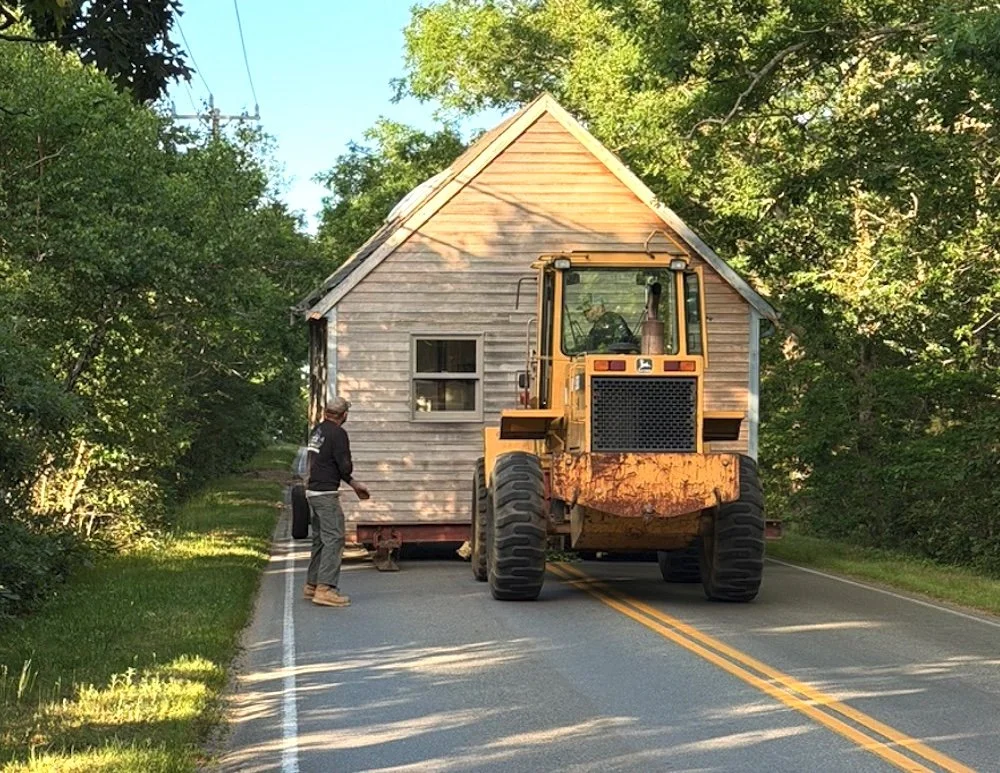
Moving a house down Old County Road in West Tisbury (June 16, 2026)
The housing crisis that plagues so many of our communities nationwide can only be solved with long-term thinking and inventive design. While we’ve done a lot with housing on Martha’s Vineyard over the past 40 years, it’s been way too little and far too slow to keep pace with the problem’s acceleration. Now, we try to build, build, build to catch up. Here’s a potential MV alternative: a full solution that requires little or no new building.
The Problem
There are roughly 17,000 existing houses on MV. About 10,000 of these are occupied for only part of the year. We need about 2,700 more year-round units for working people to call home.
We could try to build those 2,700 units of new housing at the going rate of about $800,000 each. That’s well over $2 billion, and doing so would cause widespread environmental havoc and deeply disrupt the character of our community.
This will never happen. We can’t build our way out of this.
The Alternative
But this could happen: we could solve the crisis by reclaiming some of our existing housing stock. Five keys could unlock the puzzle:
(1) Year-Round Occupancy Restrictions: Purchase permanent deed restrictions from willing property owners who commit to year-round occupancy (no short-term rentals). We’ve already begun to do this. Each costs an average of $150,000. We could create 1,800 new units for roughly $270 million.
(2) Move Houses Slated for Demolition: Many reasonably good houses are being demolished to make way for others. Move, refurbish, and equip these houses with permanent year-round occupancy restrictions. We’ve already begun to do this. Each costs an average of $120,000. We could create 200 new units for roughly $24 million.
(3) Shared Equity Appreciation Loans: Help people get into the existing housing market with low interest down payment assistance loans and equip those houses with permanent year-round occupancy restrictions. Each loan costs about $250,000. We could create 300 new units for roughly $75 million.
(4) 10-Year Lease-to-Locals Program: Some of our towns are participating in Lease to Locals. Homeowners are being paid to make their homes available for year-round occupancy on a year-to-year basis. Get 10-year commitments. Each would cost about $100,000. We could create 400 new units for roughly $40 million.
These four keys could provide the 2,700 homes we need for working people who earn up to 240% of the area median income for just over $400 million, less than 20% of the cost of building.
The fifth key? The money to do it:
(5) The Martha’s Vineyard Housing Bank: Some of us have been working for six years to convince the MA legislature to pass a local option transfer fee of 2% on high-end real estate transfers to fund the Martha’s Vineyard Housing Bank. Eventually this legislation will pass. Projections based on recent and current real estate activity estimate that this mechanism will generate about $10 million a year.
Additionally, our towns could use short-term rental fees and Community Preservation Act Funds to augment transfer fee proceeds to buy down units for those with low incomes, and to build when specific circumstances make it the best option (preferably on previously developed land).
In a few decades, our problem could be solved.
Ready Set Go!
This is only a conceptual sketch. Countless details will need solutions. What matters now is getting that fifth key in hand. Once we pass the legislation, we can launch.
Then comes the hard part: banding together as a region to spend those funds ingeniously and efficiently. We can do this, without wrecking our island or breaking the bank.