
One Island, One Town
December 19, 2025 – John Abrams
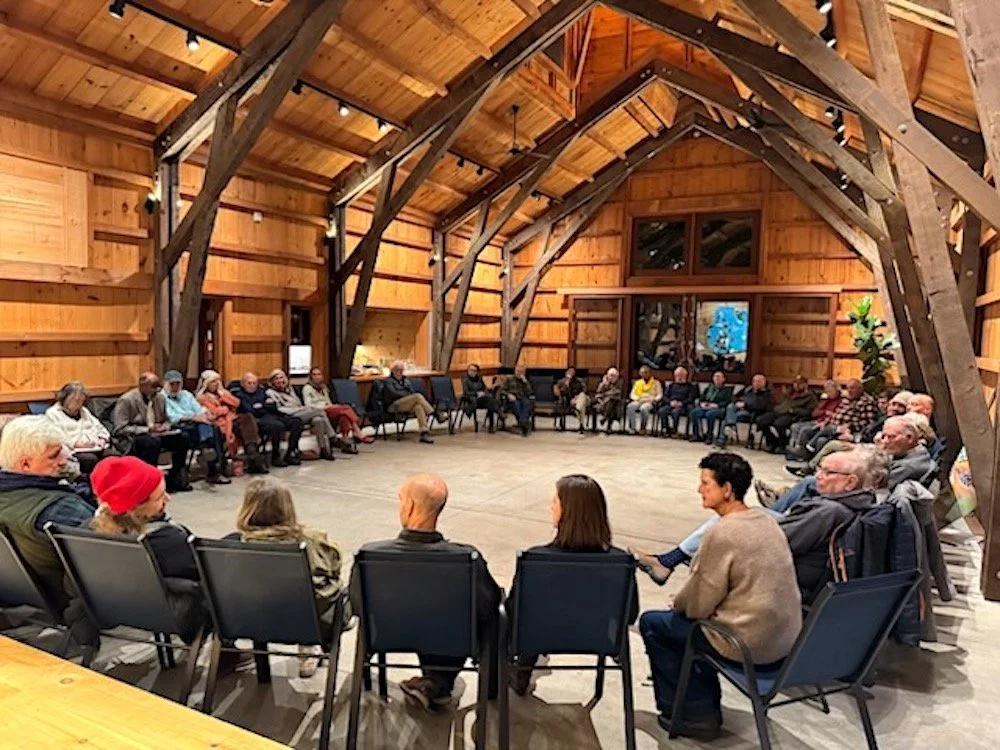
This essay was recently published as an op-ed piece in the Martha’s Vineyard Times. For those of you not connected with the island, some of the references might be obscure. As always, I’m happy to answer questions. Some of you tend to communicate with me directly about these posts. That’s fine, but using the comments section below is always best. Thanks.
In 2008, as Vineyarders worked with the Martha’s Vineyard Commission to create The Island Plan, someone asked the question: Why is our small island divided into six towns, and why is Nantucket just one?
Nobody knew for certain, but ever since I have made random observations about the idea of One Island, One Town. Recently, at Stillpoint, I gathered with a group of about 40 Vineyard residents to discuss the idea. At least one selectboard member was there, along with several county commissioners, planning board members, and others involved in island government.
It soon became clear that “regionalization” is no longer an unspeakable term. There is broader island acceptance of the view that various island-wide efforts have been successful, that more will emerge, and that our lack of regionalization can be a major impediment. Although I would hardly say there was widespread support for the radical One Island, One Town idea, nobody scoffed.
I’m not advocating here. I’m just saying that, as people who all occupy the same island, we need to learn more about how it could work best. We live and work all across the island, we share the same water and air, and we batten down the hatches against the same impending storms and clean up together in the aftermath. We are islanders, not townspeople.
None of us know the economics, the cultural ramifications, the environmental effects, or the impact on our human resources of becoming one town with six component villages. We don’t know because we have never seriously considered it and done the necessary research to know the likely pros and cons.
I think we should know.
A useful starting place is an anecdotal comparison with our sister island of Nantucket, which has one town with a single governing body—and they get stuff done!
FOOD WASTE
Faced with an impending landfill shortage in the 1990’s and the prohibitive cost of shipping waste off-island, the town of Nantucket built a mixed-use composting facility to process most of the island’s organic waste. After some early missteps, this facility is working successfully, and they have added a massive leaf and yard waste facility that makes 30-40,000 yards of fine compost annually and sells it reasonably to growers.
Nobody would say that shipping organic waste at huge cost and making it into a toxic pollutant is a better solution than composting it locally and making it into a valuable product, but nothing significant has happened in Vineyard towns. The exceptions are private efforts. Since 2016 the MV Vision Fellowship has tirelessly supported on-island food waste processing. Currently, they are bringing rapid food waste recyclers to island schools and transfer stations. And hats off to Island Grown Initiative for giving commercial composting a valiant shoestring attempt with a pilot program using an old (and now defunct) drum composter.
The food waste recyclers are a good start but doing it town-by-town is cumbersome, inefficient, and only a partial solution, even if all six towns ultimately participate. In the quarter century since Nantucket decided to process as much waste locally as possible, the Vineyard has gone the other direction—load it up and ship it out. Waste processing has not become a priority here because we have a (poor) stopgap solution.
HOUSING
Let’s compare approaches to the islands’ shared housing crisis. Since 2019, the town of Nantucket has appropriated and bonded roughly $150 million to solve the problem while our six Vineyard towns combined have appropriated less than $10 million. Embarrassing, isn’t it?
Soon, Nantucket will add roughly $6 million per year in short-term rental fees to the housing pot. Short-term rental activity is a major contributor to the crisis, but our towns have resisted using the revenue they generate for housing solutions, stating that they need these funds to keep tax rates down. Why here but not there? Is it because our fragmented governance is much less cost-efficient?
Because Nantucket is one town, they can afford a well-staffed housing office, whereas we have six different affordable housing committees with only part-time administrators. Fortunately, the Martha’s Vineyard Commission provides us with an effective housing planner, and our regional housing authority provides some valuable services. But these are nowhere near enough. The ultimate creation of a regional housing bank will have significant impact, but only if we do it as an island.
Our six towns could share professionals, but we mostly don’t, except when it’s baked into the structure, like the Martha’s Vineyard Land Bank. The Land Bank is professionally staffed to serve the entire island. One central organization with six town advisory boards that must approve any projects done in their town. It has worked seamlessly for 30 years without usurping local preference. Can you imagine if we had six land banks, all barely staffed, like we do for affordable housing?
CHARACTER
The idea of a single town is often dismissed due to concerns about losing the character of the individual towns. That may be a red herring. Look across the water again, in the other direction. Barnstable (76 square miles, about our size), is just one town, comprised of the seven villages of Hyannis, Barnstable, West Barnstable, Centerville, Osterville, Cotuit, and Marston’s Mills.
Although Barnstable has been one town since 1639, its villages could not be more different (Hyannis is nothing like Cotuit!). Each village maintains its character and some services are village-based, while the big ones (public safety, education, governance, planning, zoning) are professionally staffed under the auspices of town government. It could be a useful model.
At the Stillpoint gathering, it was suggested that we are “organically” moving toward regionalization. In addition to the Land Bank, the Vineyard Transit Authority and the Martha’s Vineyard Commission serve the entire island and do it well. As does our regional high school, which desperately needs renovation, and is taking the dramatic step of a unified island-wide vote so one town can’t sink the project.
Organic is okay but haphazard; it’s hard to imagine how six towns will ever produce the unified island-wide zoning we need, or make a comprehensive bike transportation system, (or solve the waste problem or the affordable housing crisis, for that matter).
We’ve never taken a hard look at the benefits and detriments of the full One Town option. Maya Angelou once said, “When you know better, you do better.” Could we study, in a serious way, the impact of becoming one town?
We should. Let’s know better.