
Here Comes the Sun
March 6, 2026 – John Abrams
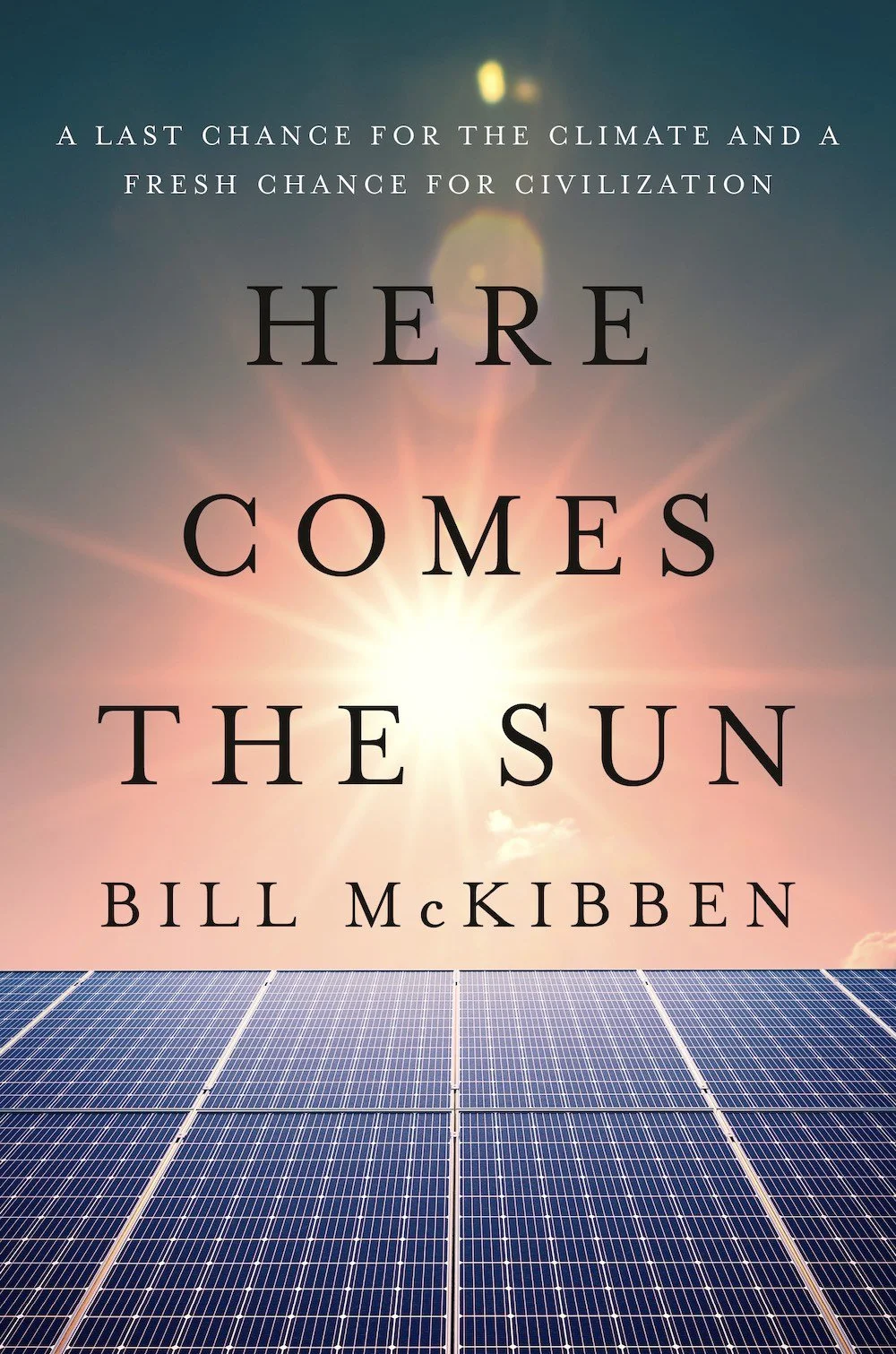
Bill McKibben recently said that two of the defining inventions of the last 100 years are nonviolent peaceful protest and the solar panel. I’ve been meaning to write about his new book, Here Comes the Sun, for some time, and that statement inspired me to pick up my pen.
In Minneapolis we may have seen the highest recent expression of sustained nonviolent protest; it overcame and ousted a force with unlimited ability to violently assault citizens. That’s monumental. Will 10 million people show up for No Kings Day on March 28th? As Americans rally and Trump tumbles, tipping points may be in sight.
And, as we continue to confront the thorniest problem of all—climate change—the entire world is accelerating the solar and wind revolution at an extraordinary rate. Despite Trump’s efforts to kill it, his efforts have little impact. Ultimately, he’ll get tired of losing a fight he can’t win because the genie is out of the bottle. As McKibben says, “By far the cheapest way to make energy has become pointing a piece of glass at the sun. The second-cheapest is to let the breeze created by the sun’s heating turn the blade of a wind turbine.” And the rest of the world doesn’t care about the nonsense of U.S. politics in this regard. As the Trump administration battles against renewables, China, Europe, India, and Africa pick up their pace and benefit from our backwardness.
The renewables revolution is even booming in Texas, the center of the American fossil fuel industry. While Trump is crashing renewable energy projects right and left, they are popping up everywhere in Texas. He’s playing whack-a-mole with moles that can’t be whacked, due to economics. The same thing that killed the nuclear power industry—economics—is declaring solar the hands-down winner. Some things can’t be dismantled, and McKibben makes the case that solar energy is one of them—it has become inevitable.
But he is hardly sanguine, saying, “I have to be honest: There’s at least some chance we’ve waited too long already, that the climate die is cast. If the gnarliest predictions about how soon the Atlantic currents shut down or the Amazon turns to savanna are true, then all the solar panels we can imagine won’t come quickly enough. I firmly believe that activists and engineers are the antibodies a feverish earth has summoned to save it, but I also know that sometimes fevers don’t break and people still die.”
This all comes as Trump has just begun another ugly oil war. He thought he wanted Venezuela, but their oil industry is ravaged. Since Iran’s is apparently in better shape, Trump has now moved his battlefield from South America to the Middle East. It appears that he wants all the oil just like he wants all the money. But it won’t do him any good. Trump’s efforts often yield results that are exactly the opposite of his intention. For example, by placing an oil embargo on Cuba, he pushed them to look elsewhere. Last year Cuba’s imports of Chinese solar panels grew by a factor of 34, faster than anywhere else in the world. They’ll probably be weaned from oil long before the rest of us.
I don’t have many heroes. There’s a large collection of people whose lives and work I admire and respect, many of whom inspire me each day. But heroes? Not so many. McKibben, our most relentless and inventive climate advocate and activist, is high on the short list.
In 1989 I read his book, The End of Nature, which marked the beginning of public awareness about the threat of climate change. I remember the moment I finished that book. I thought, “This is about as bleak and gloomy as can be. Brutal. There’s gotta be a bright side.”
McKibben, too, worried that the book left readers to conclude that the situation was hopeless. He followed with Hope, Human and Wild: True Stories of Living Lightly on the Earth, in 1995, an intentional recalibration. I remember no specifics about The End of Nature, but I vividly recall the three major stories he told in “Hope” about places where humans and nature had achieved a semblance of balance and co-existence—the Brazilian city of Curitiba, the state of Kerala in southwest India, and the Adirondacks in New York. Those stories confirmed my sense that positive climate action can come through small actions and innovations by people everywhere and reassured me that the work of the company I cared for was, in some modest way, a part of the solution.
But, as impactful as McKibben’s many books and non-stop activism have been across four decades, there’s never been anything like his new, compact, knock-your-socks-all-the-way-off book, Here Comes the Sun. The world we live in, and renewable energy, have changed dramatically in recent years, and McKibben is the perfect guide to the opportunities, risks, and work that now need attention.
I’ll share just a few quotes (with some limited paraphrasing and editing) to hit some high points:
“As it turns out, weaning the planet off fossil fuels would mean far less mining and a sharp reduction in useless economic activity. Forty percent of the world’s ship traffic, for instance, consists of moving coal and gas and oil back and forth across the ocean to be burned, a delivery job the sun accomplishes each morning as it moves across the heavens.”
“Relying on energy sources that are abundant instead of scarce could even reconfigure our ideas of competition and conquest. Unlike oil and gas, sun and wind can’t be hoarded. If fascism scares you the way it does me, figuring out how to break the centralized power of the fossil fuel industry is a key form of resistance. We have the chance to join in a great global project, providing affordable energy to every human community even as we stave off our greatest threat. It could prove a unifying mission for a divided world.”
“In 2014, The Economist held that ‘solar power is by far the most expensive way of reducing carbon emissions’; but a decade later, in 2024, The Economist put out a special issue devoted to solar energy that said, ‘An energy source that gets cheaper the more you use it marks a turning point in industrial history.’ The enraptured editors of The Economist now call it ‘the steepest drop in the price of one of the basic factors of production that the world has ever seen.’ It’s a drop, they continued, that essentially faces no limit. ‘In contrast to earlier energy sources, solar power has routinely become cheaper and will continue to do so.’”
“At the moment, we pay for fuel, over and over, our whole lives. The truck pulls into the driveway, the fat hose uncoils, the tank fills, the bill arrives. This is what made the Rockefellers rich—the simple fact that you have to write them a check every month for a new shipment. But solar, wind, and batteries simply aren’t like that. Once you’ve built the equipment to catch and store the energy it is delivered for free. The bottom line is completely remarkable: it is estimated that the rapid transition to renewable energy would, net, save the world 26 trillion dollars in energy costs in the coming decades. The faster you do it the more you save, simply because you avoid the costs of all those visits to your driveway that truck otherwise makes.”
“It’s hard to explain how different this is than the way we viewed energy economics until almost yesterday. The old idea was that the transition to renewable energy, though perhaps necessary to ward off the impossible costs of the climate crisis, would be ruinously expensive, and hence should be put off as long as humanly possible.”
That’s no longer the case.
And the final piece of the puzzle is batteries, and the mining that must be done for the materials to make them.
“Eventually batteries degrade enough that they need to be recycled for their component parts, and luckily the stuff inside them—lithium, cobalt, and so on—is valuable enough that people have been hard at work figuring out how to make that recycling happen. The biggest American plant to do so opened in 2023 in Nevada. In highly technical terms, you pour batteries in one end, and at the other end you collect their component parts—about 95 percent of the minerals come back, big sacks of lithium powder and piles of metal. What does all this add up to? A 2024 report from the Rocky Mountain Institute predicted that by 2050 we’d have done all the mining we’d ever need to do for battery minerals; we’d just take them out of service and recycle them, over and over again. Each year we learn to build batteries with less lithium, less cobalt, less nickel; improving that efficiency by 6 to 10 percent a decade is enough to offset the recycling losses, and we’re doing far better than that already.”
“Summarizing the Rocky Mountain Institute report, futurist Cory Doctorow put the 125 million tons of minerals we’ll need between now and 2050 in context: ‘It is one-seventeenth of the amount of fossil fuels we dig up every year just for road transport. In other words, we’re talking about spending the next 25 years extracting about 5.8 percent of the materials we currently pump and dig every year for our cars. Do that and we satisfy our battery needs more or less forever.’”
That’s just a sampling. There’s plenty more in this hopeful and deeply thoughtful book.
I urge you to read it.